Alain Darlan
Alain Darlan, whose name appears just one time in my book, nonetheless played an important role in the story, starting when he was stricken and partially paralyzed by polio while in Algiers in November 1942. Historian Rick Atkinson wrote in The Army at Dawn that Darlan “was so reduced by polio that his coffin had been ordered.” Alain’s father, Admiral of the Fleet Jean Louis Xavier François rushed from France to his son’s bedside. Admiral Darlan was briefly held under house arrest by American forces, then coaxed to execute “the Darlan deal,” in which he used his considerable influence to persuade French forces in North Africa to forsake Germany and join the battle against the Axis. The elder Darlan was assassinated under still-mysterious circumstances on Christmas Eve, 1942. (I owe a big chunk of chapter 26 “Ye Are Forgers of Lies” to Alain Darlan)!
It is in the aftermath of these events that Alain’s story takes an interesting turn. President Franklin D. Roosevelt, who had established a center for the treatment of polio in Warm Springs, Georgia after he was crippled by the disease, arranged for an American military aircraft to transport Alain Darlan and his wife Annie to Warm Springs for therapy. Although he used a wheelchair for the rest of his life, Alain made remarkable progress at Warm Springs. After receiving a hand-written letter from Alain in August 1943, President Roosevelt replied: “I am very happy to have your letter and especially to know that it is the first letter that you have been able to write with your own hand since the attack of poliomyelitis. Also, I hear that you are making excellent progress at Warm Springs and I hope that you will keep up the good work.” While at Warm Springs, Alain divorced his wife Annie, and married Phyllis Debrick, a nurse who had also cared for President Roosevelt.
Since there is so much packed into what you are about to read, I briefly considered publishing nothing but this photograph and its caption as the contents of this newsletter.
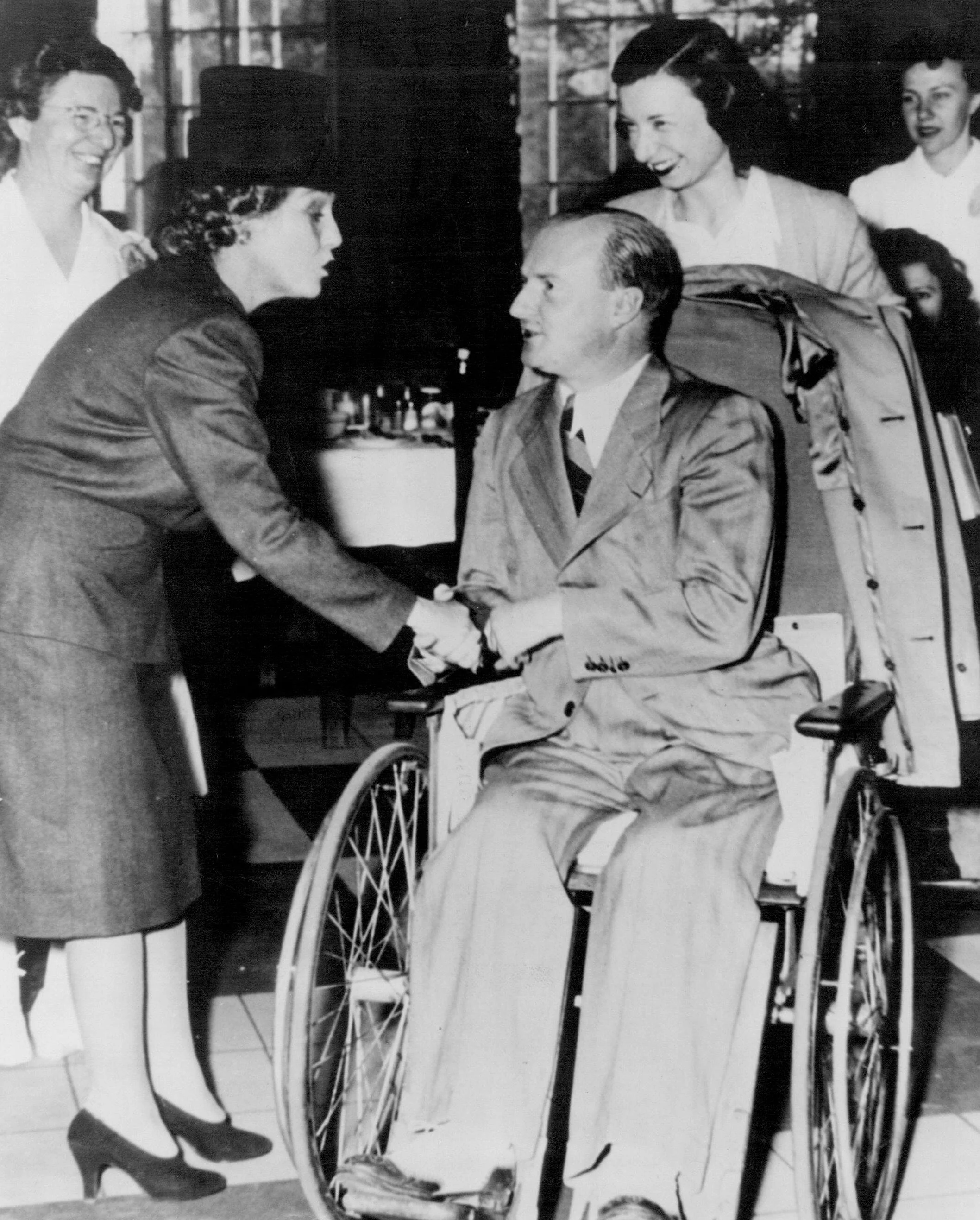
Alain Darlan, a victim of poliomyelitis, and son of the late Admiral François Darlan, at the polio treatment center established by FDR at Warm Springs, GA, seen here greeting the actress Mary Pickford, with his first wife Annie standing behind his wheel chair in March 1944.
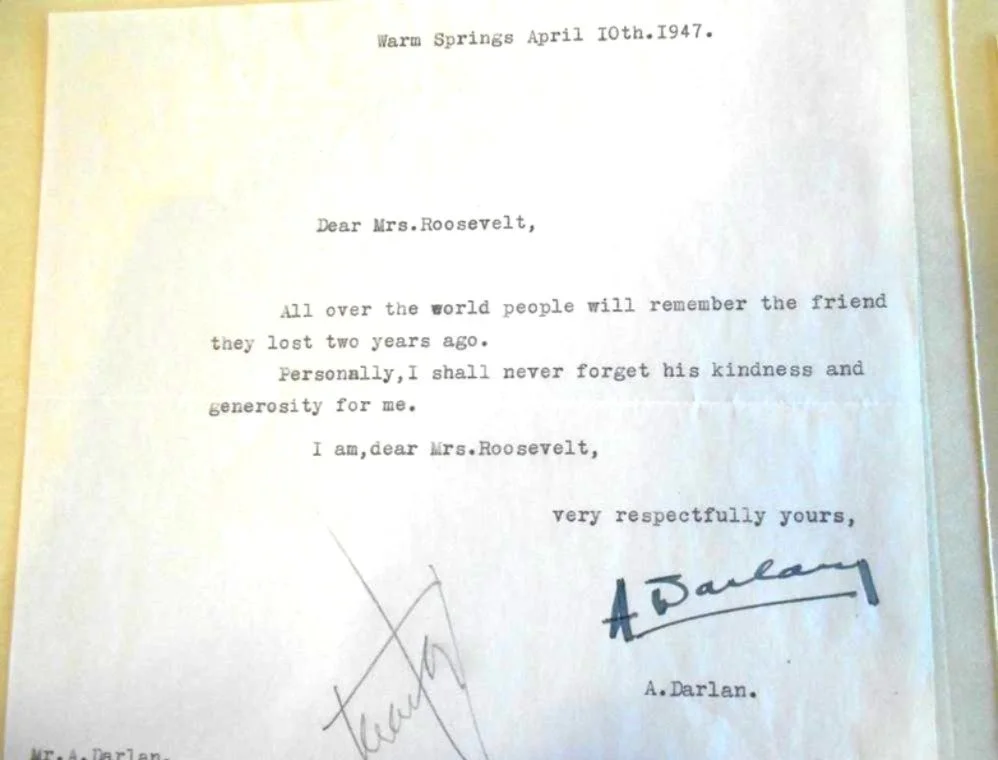
When my book was in its early dream stages, I made a research trip to the Franklin D. Roosevelt Presidential Library and Museum in Hyde Park, NY. There I discovered the letter shown below, from Alain Darlan to Eleanor Roosevelt, written two years after FDR’s death.
Dear Mrs. Roosevelt,
All over the world people will remember the friend they lost two years ago.
Personally, I shall never forget his kindness and generosity for me.
(Signed) A. Darlan
Alain Darlan died on May 10, 1983
Thanks for reading,
Bill
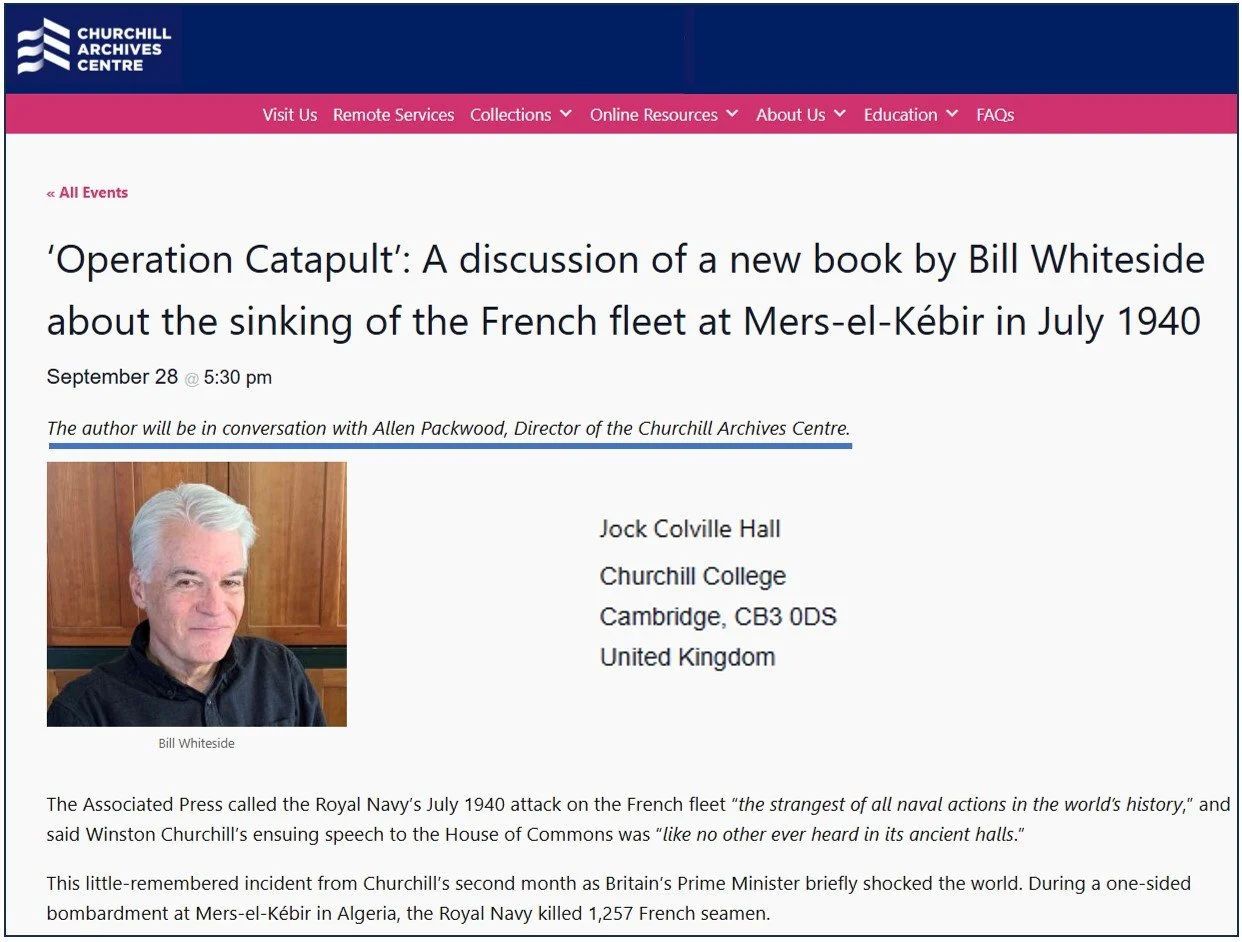
PS: Why, you might ask, does my mug appear on the Churchill Archives Centre’s website? My book project became very real after my three-day immersion in historical letters, telegrams, diaries, and manuscripts at the Churchill Archives Centre at the University of Cambridge way back in 2012. I am excited to announce that I get to return to Cambridge for a discussion of Operation Catapult with Allen Packwood, Director of the Churchill Archives Centre. If you’ve read this newsletter for any length of time, you probably have a sense of my veneration for John “Jock” Colville, Winston Churchill’s personal private secretary. The fact that our discussion will take place in Jock Colville Hall at Churchill College makes this even more special. Our discussion is scheduled for September 28 at 5:30 PM, and is open to the public. Here’s a link to the web page.
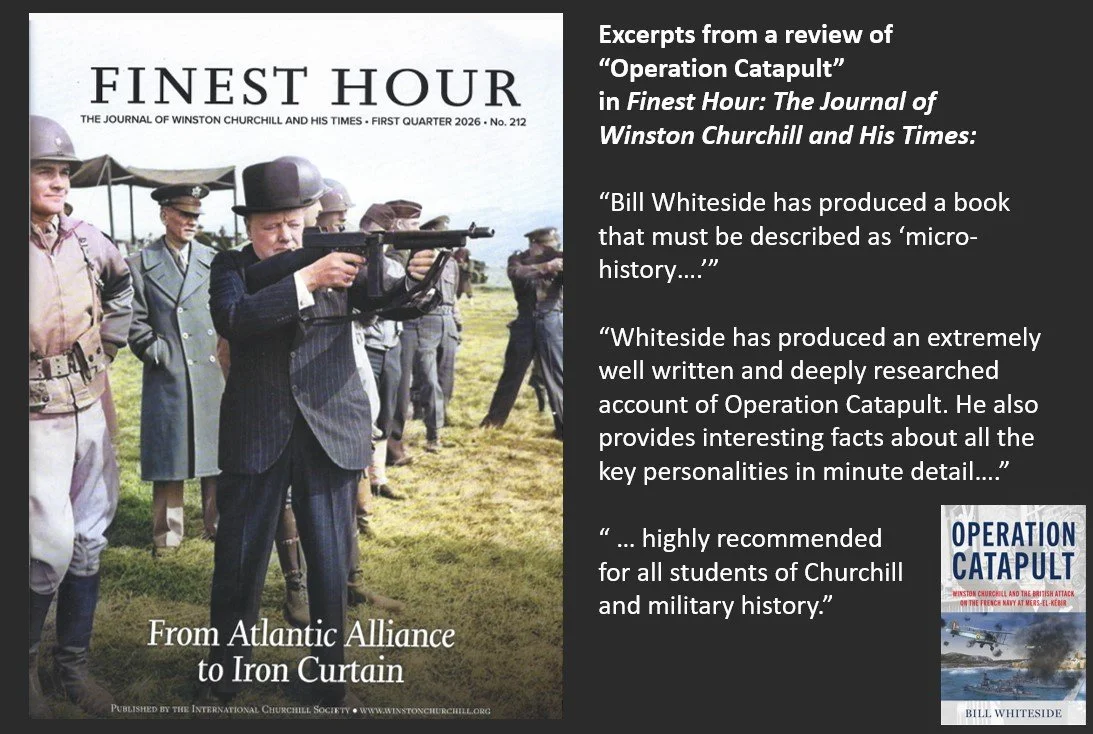
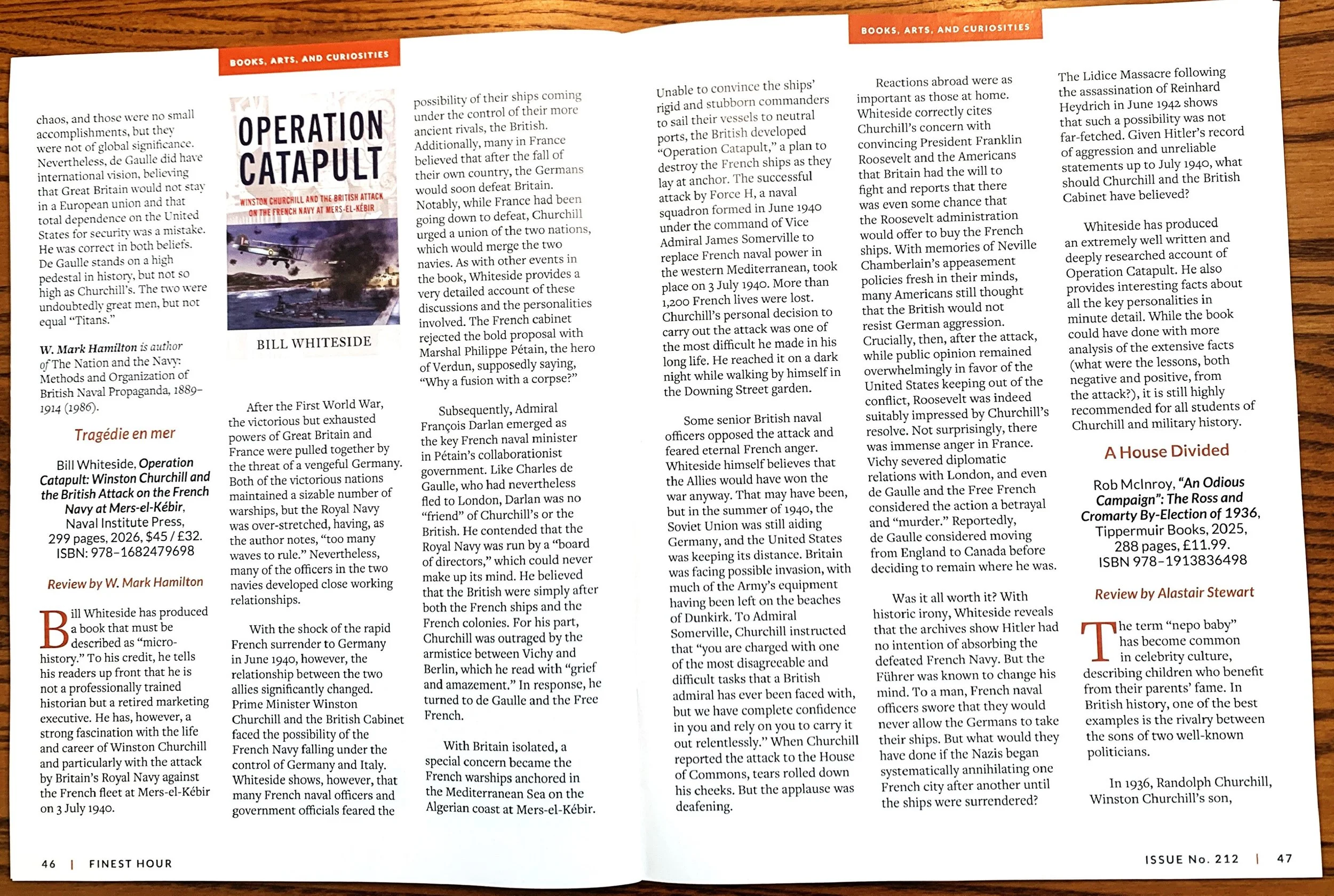
PPS: When I first thought about writing a book about Winston Churchill, a brief mention in “Finest Hour: The Journal of Winston Churchill and His Times” was one of those “wouldn’t that be wild?” far-off dreams. As this book experience goes, seeing and holding this new issue, open to the “Operation Catapult’s” review on pages 46-47, was second only to holding a physical copy of my book for the first time.