Winston Churchill - Off the Record
Of all the books I read for my research, this is the only one that I intend to go back and read again from cover to cover.
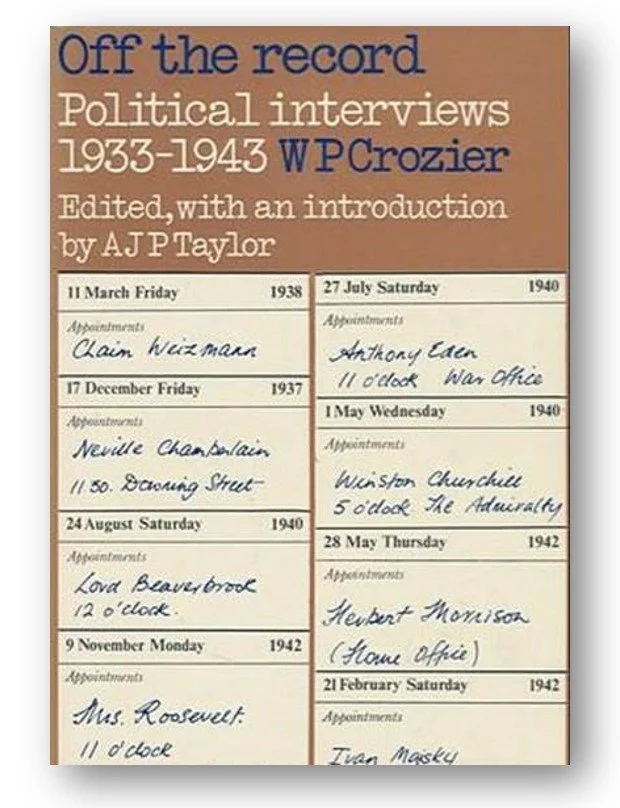
As the title suggests, Off the Record: Political Interviews 1933-1943 by W. P. [William Percival] Crozier is a collection of officially off-the-record interviews of Winston Churchill and other men (and one woman) of note. I believe these conversations do not exist anywhere else.
Crozier, the editor of The Manchester Guardian, died in April 1944. After several attempts by family members to organize and publish his interviews, his papers were donated to the Beaverbrook Library. To our good fortune, the eminent historian A.J.P. Taylor took up the challenge from there. In Taylor’s telling, “Seeking employment after concluding my life of [Lord] Beaverbrook I have prepared this selection for publication.” The collected interviews were published under W.P. Crozier’s name, “edited and with an introduction by A.J.P. Taylor” in 1973.
Taylor notes in the book’s Introduction: “Crozier listened, asked questions and departed…. The interviews were not for use in the paper. They provided background for Crozier himself. Later, I suspect, he began to think they might make material for a book.” Taylor adds “Cozier was a man who liked talking to a man who liked to talk.” Winston Churchill, of course, was a man who liked to talk. Crozier interviewed Churchill off the record 16 times, first on October 13, 1939 when Churchill was First Lord of the Admiralty, and for the final time on October 22, 1943.
Truth be told, there are no gobsmacking revelations in Crozier’s pages. Instead, there are quite a few candid, enlightening, and sometimes entertaining insights from his conversation partners.
Here are a few of the best stories that Crozier shared from his conversations with Winston Churchill:
Let’s first get this out of the way: Crozier mentions several occasions when Churchill jovially invited him to partake of a strong drink before settling in for a conversation. On August 23, 1940:
As usual, he offered me a whisky and soda, and I said I did not
take these things. Why? I said I did not care for them and I had
had trouble with an ulcer. ‘Whisky supposed to be bad for it?’
he said. I said yes. ‘It would probably be the very best thing for it’,
he said with a grin.
And on March 20, 1941:
He protested vigorously when I would have neither wine nor
brandy and said he was sure they would do me good.
Then he said pathetically ‘Well, I work very hard and I think
I am entitled to a little.’ When he found out that I did not smoke
either he looked hard at me and said ‘Good God, man,
you have got nothing that you can give up.’
Churchill’s predecessor Neville Chamberlain was widely reviled in April 1940 for his claim that Hitler had “missed the bus” when he failed to attack Britain and France when they were at their weakest. In that light, this exchange from July 26, 1940 is startling:
About the improvement in our position he was cheerful and confident.
It was obvious that a great change for the better had come over the situation
since the French collapse. He said so. ‘We are much better off now than
we were a month ago, and if we have another three months, if he does not
invade us for another three months, I think that’ – he looked at me and made
a wry face – ‘he will have “missed the bus”.’ I said ‘For goodness sake
don’t say that in public’, and he said solemnly ‘No, there’s a time to say things
and a time only to think them!’
For all of his optimism in public, Churchill was more reserved in his conversations with Crozier. With regard to the Battle of the Atlantic he stated on March 20, 1941
‘We have a good lot of people at the Admiralty, a really good lot,
and we shall pull through – I know we shall pull through.'
He stopped and said ‘But only just.’
Churchill shared a few candid revelations, which Crozier always tempered with discretion in his notes. This is how he recorded a statement by Churchill about aircraft production early in the war: ‘We are turning out now about [number omitted] planes per week.’
I love this very human observation by Crozier of a Churchill moment that I can readily identify with.
Wanting to remember something, he very solemnly fished
a handkerchief out of his pocket and tied a knot in it, admitting
that he would probably not be able to remember what he had
tied the knot for.
While most of their conversations were one-on-one and were conducted in English, Sir Arther Salter, the Parliamentary Secretary to the Ministry of Shipping was present for one, and mentioned that he would be casting off for America the following day. Churchill quipped: “Cras ingens tentabimus acquor” (which of course I had to look up). According to Google Translate, this converts from Latin to: “Tomorrow we shall attempt the vast expanse of the sea.” Churchill then rued “that you could not quote the classics in the House now.”
Speaking of Latin, I am old enough that I was an altar boy back in the days when Roman Catholic Mass was still routinely offered in Latin. I will confess that the only Latin phrases I “learned” were the altar boys’ rote responses in the liturgy. Speaking of Catholics and confession, I will also confess that despite my meticulous research, I definitely missed the bus here, and wish I had caught this fiery Winston Churchill quote from March 21, 1940 for my book.
Talking of opinion in America he said that he himself dated the decisive
trend of it towards us from the moment when they heard of what we had
done at Oran [used interchangeably with "Mers-el-Kébir"]. The Americans
appreciated ruthlessness in war and they were up to that time doubtful
whether we could be ruthless in order to save ourselves. They were
converted when they heard that we had gone for the French battleships
and when they knew that we would do anything rather than go down.
He was at this moment looking straight towards the fire with me on his
right hand a few feet away, and he turned suddenly towards me,
looked straight at me, and said with an almost savage glare
– ‘and we will! We will do anything!’
One final confession: when I read “Off the Record,” I skimmed through the pages, pausing only to read W. P. Crozier’s conversations with Winston Churchill. By doing so, I missed 244 interviews with 44 other men – including A.V. Alexander (first lord of the admiralty), Leo Amery, Lord Beaverbrook, Brendan Bracken, Neville Chamberlain, Anthony Eden, David Lloyd George, Lord Halifax, Sir Samuel Hoare, Leslie Hore-Belisha, Joseph Kennedy, Ivan Maisky (Soviet ambassador in London), Sir Robert Vansittart, and Chaim Weizmann - as well as one brief conversation with Eleanor Roosevelt. As mentioned above, I am looking forward to re-reading "Off the Record," this time from cover to cover.
Vade in pace (Go in peace),
Bill