My conversation with Christopher Somerville
Last Friday - July 3 - was the 86th anniversary of the subject at the heart of my book – the British attack at Mers-el-Kébir. I was thrilled to have the opportunity to join Christopher Somerville in a conversation earlier in the week. If you’ve read my book, you’ve read a lot about Admiral of the Fleet Sir James Somerville. Christopher is his grandson.
We discussed Admiral Somerville's personal torment over the British attack on his recent allies, and a remarkable incident in which the French reaction to the attack rebounded on Christopher many years later. We also discussed how Admiral Somerville overcame multiple stages of adversity via his personal initiative, and how – despite the fact that the engagement at Mers-el-Kébir was only partially successful – the admiral eventually won the deep admiration of Winston Churchill.
Christopher shared rare photographs, mementoes (including two of Admiral Somerville's model trains), and the moving story of how his long walks with his father – Lieutenant Commander John Somerville, who also served in the Royal Navy - helped add clarity and warmth to their relationship (building on the stories that Christopher shares in his book The January Man).
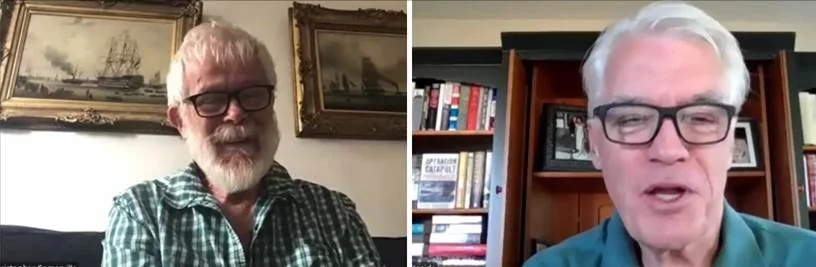
I hope you will take the time to watch the video of our conversation. To give you a sense of what to expect, here are a few excerpts from the transcript.
We first connected about a dozen years ago. I was still a software salesman thinking about writing a book. I was dealing with massive amounts of imposter syndrome waiting for someone to say, "What do you think you're doing?" My first serious research venture was when I went to the Churchill Archives Centre in Cambridge. and per their instructions, I sent them an email in advance asking about certain papers that I was interested in viewing. One of them was the collection of Vice Admiral Sir James Somerville. And they wrote back and said you're welcome to view any of his papers with the exception of this one folder. And that “R” at the bottom indicates it's restricted. And they said in order to view these files - this folder contained personal information, letters to his wife, your grandmother - I should have mentioned Admiral Somerville is your grandfather - and his personal diaries. They said you need permission from his grandson, Christopher Somerville. So, they suggested I draft a letter to run by them. and I sent them the letter and they responded that my letter to you was “perfectly adequate” which to this day I'm not sure if that was a compliment or not.
I think it wasn't.
But it worked! You were kind enough to grant permission to view his papers, and at the time I thought I was going to be writing a book that was largely about Winston Churchill. And I wrote that book, and there's a lot about Churchill in there, but probably more than anything else, it's a book about Admiral Somerville and his career, particularly the battle at Mers-el-Kébir.
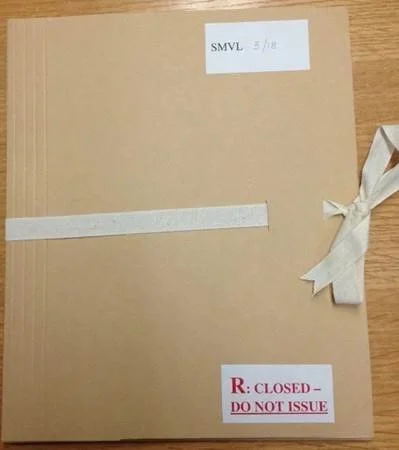
Restricted folder in the Somerville Papers at the Churchill Archives Centre
☆ ☆ ☆ ☆ ☆ ☆ ☆ ☆ ☆ ☆
[Admiral Somerville] was eventually ordered to the Pacific. He took over the Eastern Fleet and was enormously successful there too.
Although I think Churchill felt that he might have lacked the offensive spirit because essentially he put it that his job was to stay out of the way of the Japanese if he possibly could because their fleet was superior in every way, and the Eastern Fleet was a collection of old battleships from First World War and a couple of newer ones, but they were essentially old, slow, not armed properly, and a proper confrontational naval action would have been disastrous for the Eastern Fleet. So, he had to bomb installations and, you know, be a damn nuisance where he could, but he couldn't really come to action in the way that, say, the Americans did.
It was almost guerilla warfare from the sea.
Yeah, he had to be very effective. I mean just what somebody with quick wits and you know fast movement could manage, but also quite frustrating I should imagine.
And I read the admiral was horrified when Admiral Cunningham - then the First Lord of the Admiralty - asked him to leave his seagoing command to travel to Washington DC of all places.
Yes. Well, he was about the one person who could handle Admiral Ernie King, who was the American and his counterpart. And I think my grandfather had quite a coarse sense of humor. And he was quite forthright. He was funny, direct, but also, you know, humorous in in a sort of he could be quite laddish. And I think that's exactly what got through to King. So actually, Ernie King who was a - I can't remember all the stories - but he was famously grumpy and uncooperative person, and was actually rather charmed by my grandfather.
I read that when Admiral Cunningham asked Admiral Somerville to go to Washington, Winston Churchill resisted that idea. I wrote down this quote. He said: "He seems to me he knows theater, has right ideas about it, and is capable of daring action."
Yeah. So, I think it was, you know, he proved his point.
He did. He won him over. And then the last quote I had was that Churchill wrote that Admiral Somerville is “keen and sprightly in the last degree.”
I would say both those things. He really was. Sprightly is a word we don't use much nowadays, but I think he was extremely sprightly.
Yes. If anyone said that about me - especially Winston Churchill - I would start carving my tombstone right away. I would want that for posterity.
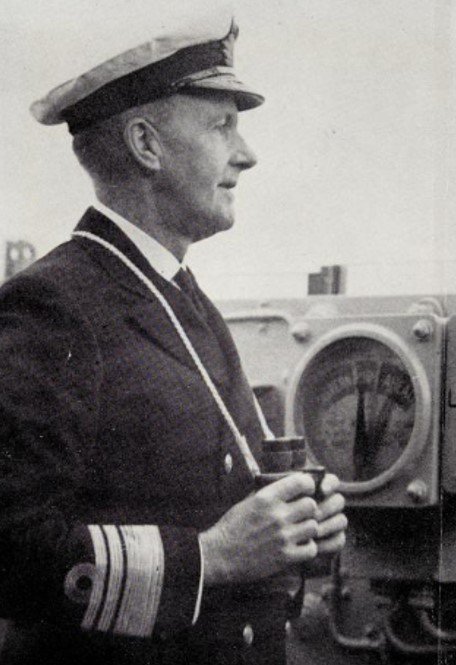
Admiral of the Fleet Sir James Somerville
☆ ☆ ☆ ☆ ☆ ☆ ☆ ☆ ☆ ☆
Was your father at Alexandria in 1940 when Mers-el-Kébir was taking place?
No, I think about that time he was in a destroyer - the Defender. And he then was sent to another destroyer - the Hero. But he was in the Med all the way through the late part of 1940, all through 1941, the toughest part. He never spoke about it partly because he was a reticent man and didn't want to, you know, sort of a aggrandize himself and also because it was not something he shared with an awful lot of people. His generation - they just didn't speak about the war. They wanted to bury it, I suppose, to a large extent. And I only heard about it what should we say 30 years after the event, 40 years after the event when he and I were on a long distance walk together and we went to the pub in the evening to have our supper and they sold a kind of beer there called Theakston's Old Peculier, which at the time was incredibly strong. It was like alcoholic treacle. And I managed to get two pints of that down dad and he suddenly started talking about the war and all the things which I'd never heard, really amazing things - bombs and near misses and blood and screams and oil in the water and smoke … and the fact that he had his commanding officer, the captain of his destroyer was one Hilary Worthington Biggs who was a wonderful ship handler. Could dodge, you know, bombs coming down from Stukas and could dodge torpedoes. Marvelous in every way, but he would not delegate. He saw it as his duty to be in control all the time. So, he had his hammock rigged up on the bridge. He peed down a voice pipe - I hope into a receptacle underneath - and he just didn't leave the bridge except for one particular call of nature. Apart from that, he was on the bridge the whole time. And dad felt … and he never let dad take … dad, I should have said was the first lieutenant. He was second in command. He was never allowed to handle a ship in action. Biggs just wouldn't let him, wouldn't allow anybody else but himself to do it. Which is probably right because actually they did all survive. But dad always felt if Biggs copped a bullet - Can I? I don't know if I can do it. I don't know the job which is quite a hell of a burden.

☆ ☆ ☆ ☆ ☆ ☆ ☆ ☆ ☆ ☆
I was going to mention I've read three of your books. The January Man, Ships of heaven. And I can't find my copy of Our War which I actually read to help me with my book. I read the January Man thinking I was going to learn about geology and about long walks - and I did. But the passages about you and your father and the relationship that evolved from that experience were fascinating.
That was a really interesting thing because I had set out just to write a book about 12 months in Britain, and you know choosing a walk for each month and pretty obvious idea, but the very young and funky literary agent I had at the time - diamond ear studs, cool boots … suggested … he said why don't you write something about your family, your dad. I must have been talking about it, and I hadn't even thought about it. I thought actually that's quite a good idea but can I write about my dad? It's too intimate, it's too soon, and especially as he was a private sort of person, but actually he'd been dead 10 years by then, and it was interesting because it enabled me to step back and see him much more clearly. And I did that really in terms of as you know in the book, a lot of it's about walks that we went on. If you walk with somebody it's much more easy to talk to them and open up with them because it's very simple - you're not face to face, you're not confronting each other across a table or across a room. Side by side. So you're speaking out that way and he's speaking out that way, and there's a layer of confrontation which isn't there, put it that way. I found it very touching and interesting to look back and try and remember what dad had really been like. He was a fantastic father. I know he was. And he was a very loving and hands-on father, too, when we were when we were little. But, you know, as a teenager, God's sake, it was the middle 1960s. You know, we've all been there.
I'd never thought of that. Walking side by side, you remove the blinders and the filters and, yes, I imagine it was therapeutic as well.
I think it really was and, it brought us very close.
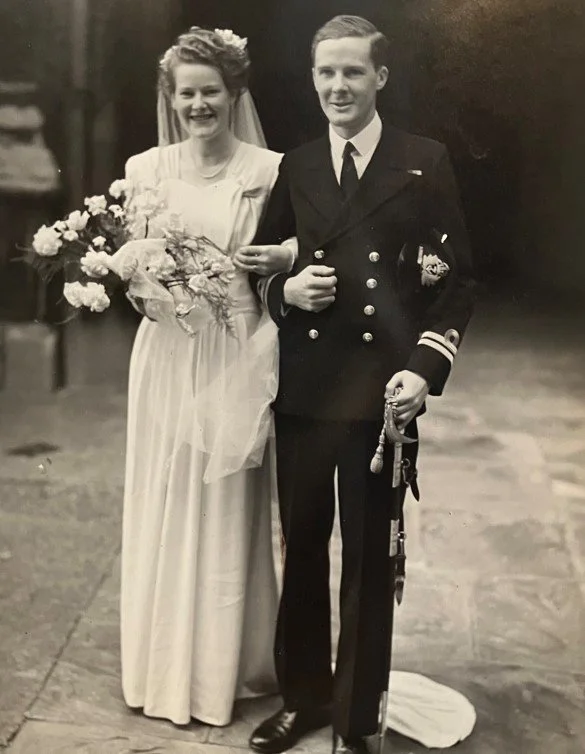
From Christopher Somerville: “My father, Lt-Cdr John Somerville, and my mother Elizabeth Payne on their wedding day, 16 June 1945. She was a red-headed Wren officer, daughter of Admiral Christopher Payne and his wife Dorothy (nee Whinney), and my father always called her ‘the toast of the Eastern Fleet’. How extremely young and earnest my Dad looks - almost like a boy dressing up his father’s uniform - except that he was no boy, but a man of 27 who had faced all the horrors of war.
☆ ☆ ☆ ☆ ☆ ☆ ☆ ☆ ☆ ☆
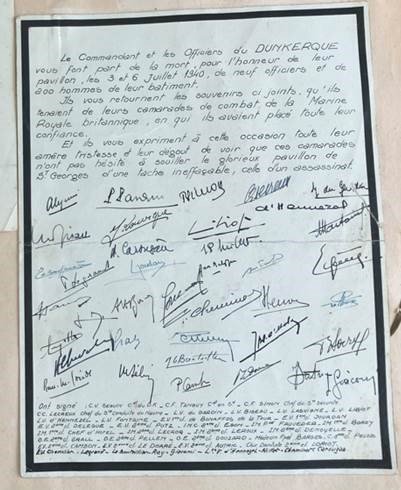
Something I wanted to ask you, going back to your grandfather, was about the aftermath of Mers-el-Kebir and the sinking of the French ships, and as if his anguish was not deep enough, you mentioned a note that he received from the surviving officers of the [French Battleship] Dunkerque.
It was actually it was actually like a sort of a funeral notice. It’s signed by all the officers, surviving officers from the Dunkerque, and it says …
The commander and the officers of the DUNKERQUE inform you of the deaths, for the honor of their flag on July the 3rd and 6th, 1940 of nine officers and 200 men from their battleship.
They return to you the attached mementoes which they had of their comrades in arms of the British Royal Navy, in whom they had placed all their trust.
And they express to you on this occasion all their bitter sadness and their disgust at seeing that these comrades did not hesitate to soil the glorious flag of St. George with an ineffaceable stain, that of an assassination.
That's a hell of a thing to get.
What a harsh message.
Well, yeah, but you can see why. And then there's the actual signatures. I found this in a scrapbook belonging to my grandfather.
☆ ☆ ☆ ☆ ☆ ☆ ☆ ☆ ☆ ☆
I told you of this incident that happened to me.
Could you share that?
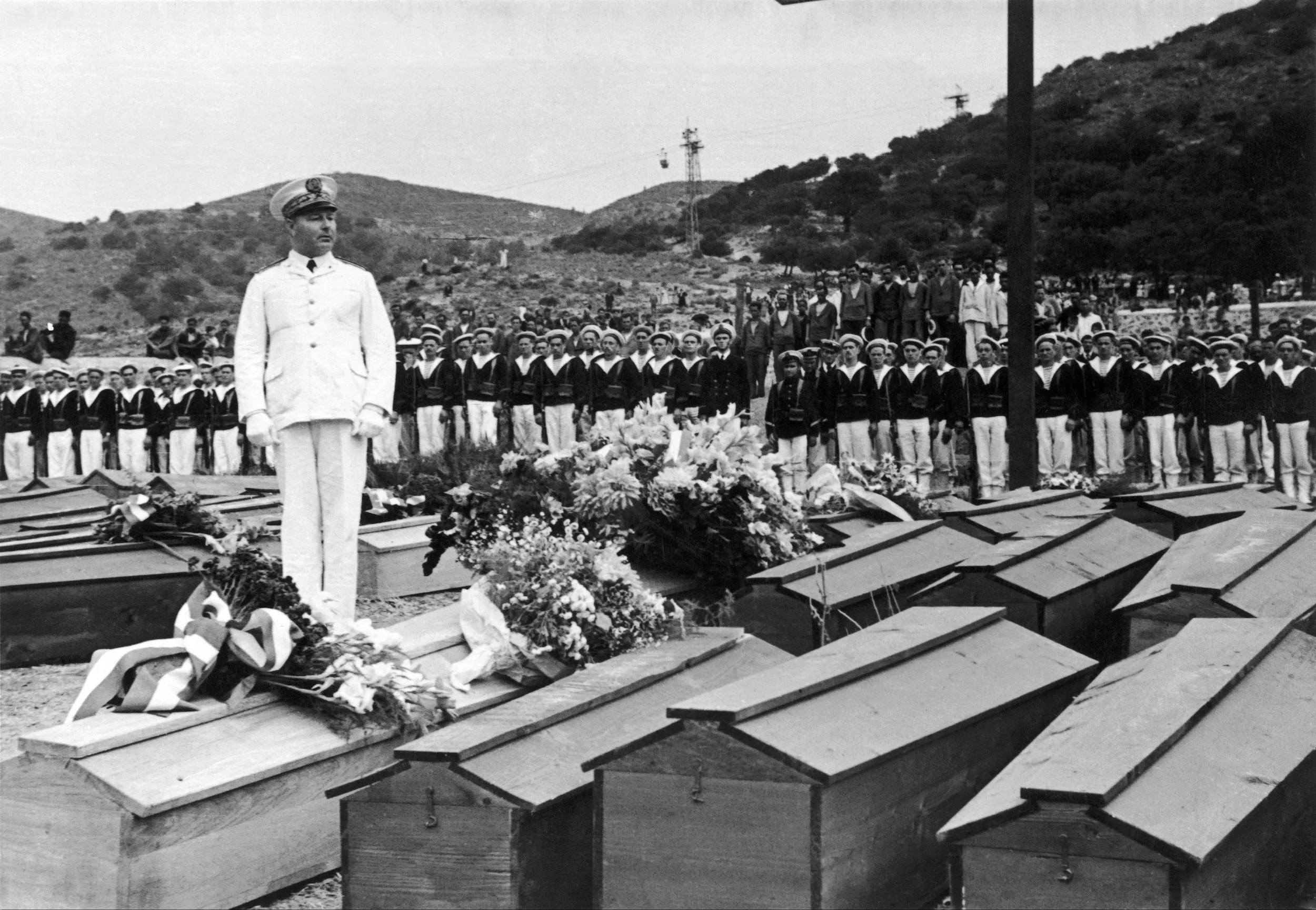
Yes. I can't remember if it was in Clermont-Ferrand or it was in Vichy, but we'll say it was in Vichy. I was on a French course as a student. I must have been 19 something from university, and in France, getting on very badly and feeling very homesick, and a girl on the course - a French girl - took pity on me or maybe I might have just met her. Can't remember. Anyway, she took pity on me, invited me back for Sunday lunch. And we went to went to her house and there was a very stately gentleman there who again I can't quite remember. I think it was her grandfather and he was, it must have been her grandfather. And we all sat down to lunch and then he hadn't quite caught my name. "What is your name again, then? “Somerville.” "Somerville?!“ Not the grandson of the butcher of Oran?!?!” And at the time I I didn't even know what he was talking about…. And then he was absolutely furious. And I think he must have lost a son or a brother or something, a cousin, at the at the action because on the wall there was quite a famous picture of the funeral party with lots of men in their tropical whites gathered in front of an enormous open grave and he sort of pointed to it, and he was absolutely furious and although he sort of recovered himself, he couldn't wait to get me out of the house, and then of course the final blow was that he had to drive me back to my lodgings or whatever it was. So it's a very sticky journey. Very quiet ride. And you know for I mean I won't say poor little me because you know he had every reason to be as he was, but he couldn't contain his anger and his disgust and having me anywhere near him.
My conversation with Christopher was one of the most enjoyable and invigorating experiences in this book adventure. I hope you will watch the entire conversation at this link.
Thanks for reading and – hopefully! – watching,
Bill
PS: We discussed Christopher’s book The January Man: A Year of Walking Britain in some detail in the excerpt above. During our recorded chat, we also touched on Ships of Heaven: The Private Life of Britain’s Cathedrals I love both books, and as I mentioned in our conversation, Ships of Heaven reads like a narrative nonfiction equivalent of Ken Follett’s great book The Pillars of the Earth.