The French Prime Minister and His Mistress
Not counting photographs, end notes, a bibliography, and an index, my book - Operation Catapult - is 251 pages long. Since they’re never quite sure how a book will be formatted until late in the process, publishers talk about a book’s length in words, not in pages. In my case, those 251 pages contain about 85,000 words. When I first submitted my manuscript, it was close to 115,000 words in length, which, I was informed, would be a deal-breaker. Initially, the prospect of cutting 30,000 words and still having a book I was proud of seemed daunting, if not impossible. It took several months, but I successfully trimmed my manuscript, and was grateful in the end. The finished product is tighter and reads much more smoothly than its bloated predecessor. To sweat down to fighting and page-turning weight, in addition to heavy doses of copy editing, I jettisoned several stories that might have added interest, but did absolutely nothing to move the story of the clash between the British and French along. One of those stories was the tale of France’s Prime Minister and his mistress.
Paul Reynaud, the Prime Minister of France, was Winston Churchill’s counterpart until late-June 1940. Reynaud’s mistress, Countess Hélène de Portes, was a constant presence in Reynaud’s life and a meddling influence in his government. The prime minister was separated from his wife, and he shared an apartment in Paris with Mme de Portes, who was 24 years younger. I was never able to confirm the details (which, as a researcher, I hate), but it is believed that Hélène de Portes husband – Count Henri de Portes – had died two years earlier. American diplomat Robert Murphy noted that any dinner invitation to M. and Mme. Reynaud was an adventure, in that “there always was a question which lady would attend.” He mentioned one dinner at which “both arrived, providing a neat protocol problem.”
The widow de Portes had a hectoring influence on Reynaud’s selection of ministers. U.S. Ambassador William Bullitt told President Roosevelt that de Portes had persuaded Reynaud to appoint Paul Baudouin to his cabinet because Baudouin was a fervent Roman Catholic and she hoped he would use his influence to change France’s strict divorce laws and thereby facilitate an expedited divorce for Reynaud. More problematic was that Baudouin shared the countess’ desire for a quick resolution to the war, even a quick capitulation to Hitler’s Germany.
When Reynaud’s friend, the author Andre Maurois, once criticized a government appointment, Reynaud responded “Ah, you don’t know what a man who has been hard at work all day will put up with for the sake of an evening’s peace.” Maurois noted the three telephones on Reynaud’s desk, one for conversations with his ministers, one for external calls, and one dedicated to calls from and to Mme de Portes.
One of my first research expeditions was to the Frankin D. Roosevelt Presidential Library and Museum in Hyde Park, NY. My first fascinating find in the archives was a letter from Bill Bullitt to an FDR underling in which the ambassador noted that the principal obstacle to a better working relationship between Reynaud and his predecessor Édouard Daladier was the clash between their mistresses: “… the lady love of each hates the lady love of the other, and … venom distilled in a horizontal position is always fatal.”
After a late-April 1940 trip to London, Reynaud was bedridden for several days with the flu. Pierre Lazareff, editor of Paris Soir called the prime minister to discuss an urgent matter and was taken by surprise when Mme de Portes answered Reynaud’s phone. “We are horribly busy, my dear,” she told him. “But come over anyway.” Lazareff was even more surprised when he arrived to find the countess seated at Reynaud’s desk, meeting with “generals, high officials, members of parliament, and functionaries, … advising and giving orders.” Finally, when Lazareff requested a private moment with Reynaud, the countess informed him: “No, he is ill. I’m doing my best to replace him.”
As he wrapped up a discussion of a mid-June 1940 meeting in France, Winston Churchill mentioned to his Cabinet that Reynaud and de Portes had departed for the temporary center of government in Tours, and impishly added: “She had a comfort to give him that was not mine to offer.”
Reynaud resigned as Prime Minister in the middle of June 1940. Countess de Portes rejoiced when the new Vichy government in France provisionally tapped Reynaud to be their Ambassador to the United States. Unfortunately, when a Reynaud/de Portes advance team attempted to cross the Spanish border on their way to a ship that would take them to America, more than two million dollars in gold was found in what they assumed was diplomatically privileged luggage. Reynaud’s appointment was quashed, and the Countess sheepishly claimed that the valuables were intended for her two children who also intended to relocate to America.
On June 28, 1940, Reynaud and de Portes enjoyed a final meal in a café near the port city of Sète. Shortly after they departed and wound their way down a hill in the former prime minister’s Renault Juvaquatre, Reynaud lost control and swerved from the road. As the car hit a tree, the load of baggage that was piled in the back seat surged and toppled forward into the front seat. Reynaud was seriously injured – accounts suggest that he was nearly scalped - and would be hospitalized for days. The countess was killed instantly. Some versions of the story say she was nearly decapitated by the tumbling, heavily-laden bags.
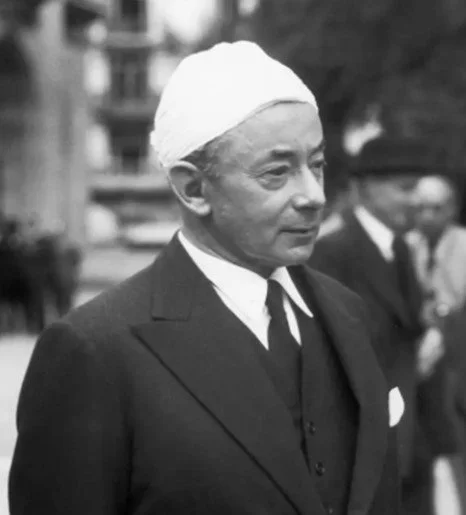
(I've never found a useable picture of Hélène de Portes.
This is Paul Reynaud after his release from the hospital)
Thanks for reading,
Bill