Question Time / Answer Time
I try to write about things that readers will find interesting … but how do I really know? To find out for sure, I encouraged my newsletter subscribers and social media contacts to send me their questions about my book.
I was thrilled - but not surprised - to learn that I am blessed with contacts whose interests are varied and who came through with well-considered questions. Here are all of the questions I received and all of the answers I provided.
The book cover shows biplanes mounting the aerial attack on the French naval ships. It's fascinating that the British did not have to rely on some of their more advanced planes. I suppose the French were taken totally by surprise.
I know you won’t be the last person to wonder about those biplanes. By the time I saw my book’s cover art, I was well acquainted with the biplanes’ role at Mers-el-Kébir. However, I remember being astounded when I first read that the Fleet Air Arm still used biplanes at the beginning of the war (and, surprising, much later). One of the principal ships in Force H (the British squadron at Mers-el-Kebir) was HMS Ark Royal, the Royal Navy’s newest aircraft carrier. The biplanes were Fairey Swordfish Torpedo-Spotter-Reconnaissance (TSR) aircraft (lovingly referred to as “stringbags”), which flew from the deck of the Ark Royal.
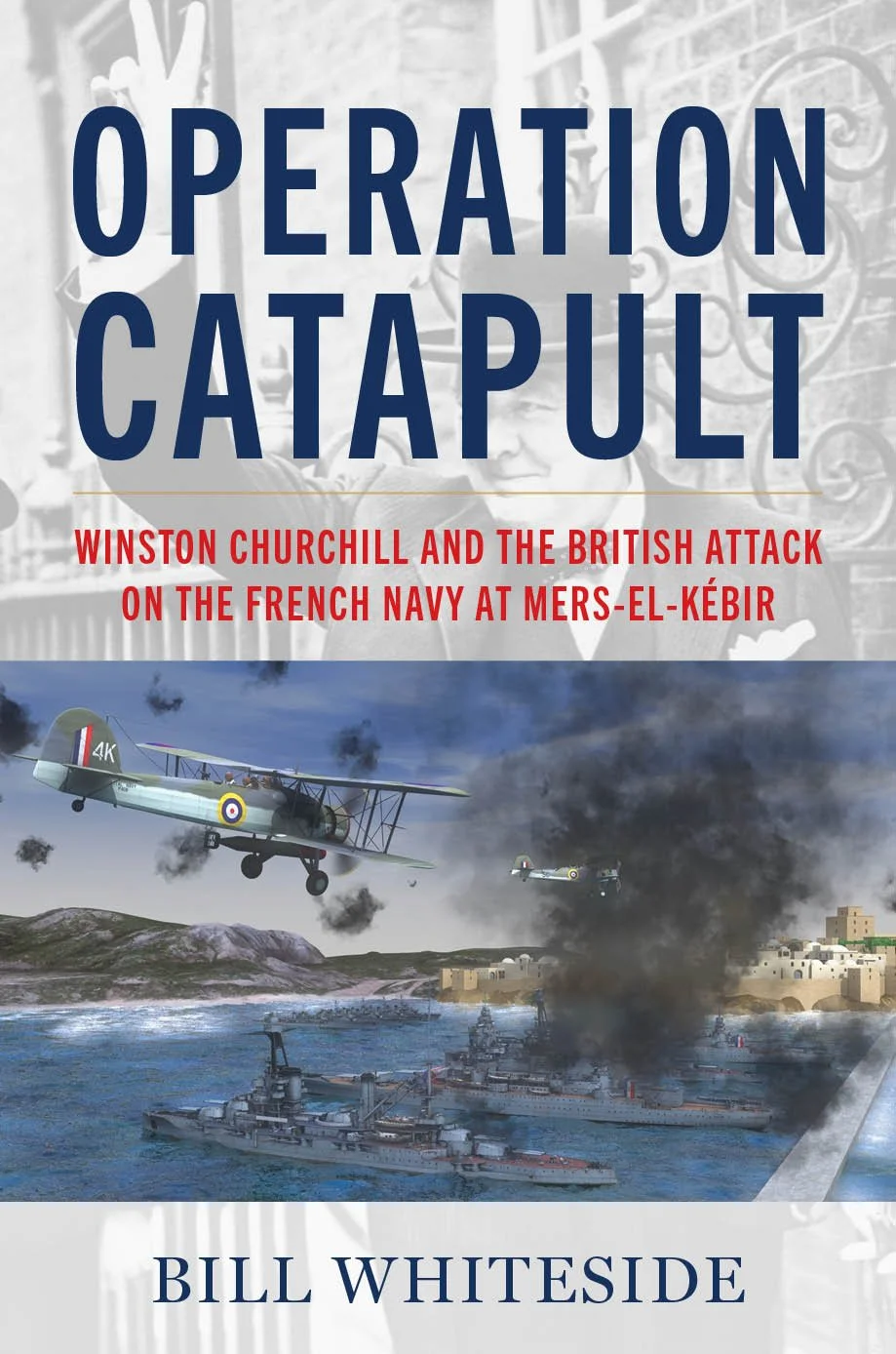
The cover depicts the Swordfish in “spotting” mode, attempting to provide feedback to the British capital ships ten miles offshore on the accuracy of their salvoes. As my book details, the Swordfish also played a significant role before the battle and an even more vital and surprising role three days later.
You should know that I could not be more pleased with the detailed accuracy of this illustration. From the details of the French battleships in the foreground to tiny grey cluster of French destroyers across the bay, to the stone breakwater in the lower right corner of the picture, to the distant terrain, to – of course – the stringbags, the artist nailed the fine points and perfectly captured a critical moment in my story. Because the harbor was so quickly enveloped in smoke, I was never able to find a compelling photograph of the battle, especially one with sharp enough resolution to print and publish. The available photos pretty much just show ships’ masts and billowing smoke. I’m very happy with the illustration that the Naval Institute Press found for the cover (as well as how they “ghosted” the image of Winston Churchill in the background).
The heart of writing these kinds of stories seems to be to humanize the players involved. What surprising tidbits did you learn as you researched the real people, and how did you work to weave those facts into the narrative?
I’ve previously written about my admiration for historian Rick Atkinson, including a whole chapter in my self-published book. I especially appreciate how he adds fascinating dimensions to the key players with short vignettes. I made copies of every vignette in his World War II “Liberation Trilogy,” (there were more than a hundred of them) and, for a long period, would read several each morning for inspiration. Relative to your question about weaving these facts into the narrative … after writing a half dozen vignettes, and trying to squeeze them into my manuscript, my book felt like a lumpy piece of patched drywall. It took a while, but I eventually sanded these sections down and integrated these passages into what I hope is a fairly smooth finished product.
I’m going to save those really good tidbits for the book, but here are a couple of humanizing (or perhaps dehumanizing) stories that I also really liked, but elected not to include. (They’re “murdered darlings” in writer-speak).
Churchill’s aide Brendan Bracken was once quoted as stating that France’s Admiral François Darlan was “a Judas who will not hang himself.” I absolutely love that quote, but it was in a context that was just unwieldy enough that it would have stood out forever as one of the lumpy patches I mentioned.
One of the French books I bought from an online bookseller in Paris was written by a French sailor who was involved at the battle of Mers-el-Kébir. He mentioned that during the battle he noticed a comrade with blood streaming down his arm. When the author suggested getting the wound treated, his comrade stated that he had a British flag tattooed on his arm before the war. When the fighting started, “he just took his razor and, cutting into the flesh, cut out the Union Jack stained with shame.” I live for stories like that! … but this one (along with a couple of other stories in his book) just seemed too sensational to be credible, so I left it out.
How did you find the process of revising your text? I know you write from the heart, but when an objective outsider reads it and makes strong suggestions, how did you incorporate their suggestions without feeling like you were losing key content or nuance? Were there any sections you really fought for, and decided to keep despite editorial suggestion? How did the editor respond?
The edits came in two waves. Before the Naval Institute Press signed me, they subjected my manuscript to a peer review by two naval historians. The historians had the right to remain anonymous. The one who shared his name was blunt, occasionally harsh – and enormously helpful. He pointed out some factual mistakes (relatively minor but no less mortifying), and made a number of suggestions. I added one small section based on his comments and that is now one of my favorite parts of the book. It’s the section (just two pages) that I go back and read most frequently. He also inspired me to add back a small story that I had recently deleted. I have a much tighter and more accurate book thanks to his input.
The second wave was a copy edit of my “final” manuscript. I used to write for my own small business, then self-published a book about my research journey three years ago. I have never been edited before, and was not looking forward to being critiqued. Each of my 27 chapters was returned in a separate Word file, and I literally cringed as I opened each chapter, nervous about what I would face. As it turned out, that step was even less stressful than the peer review and also quite helpful. The editor reasonably questioned several factual statements, and she pointed out more grammatical and punctuation errors than I ever believed I was capable of producing. My book is definitely better as a result of her sharp eyes and this process.
There were a number of statements and small sections that I fought for, quite confident that that they belonged. I was grateful that the editors did not dispute any of these challenges.
As you did your research, did you come across any evidence on whether the British government and military participants had any conscientious concerns either before or after the action on the French Navy?
One of the things that drew me into this story is that with the exception of a handful of senior officers, every single British officer that I’m aware of was adamantly against taking deadly action the French Navy.
Many of these officers were close friends with French seamen. They had been quartered on each other’s ships in the weeks leading up to the Anglo-French split, and had fought together against the German and (briefly) Italian navies. They were horrified at the prospect of firing on their recent allies. Although some were very outspoken in their opposition, they ultimately had to follow their orders. There was not as much resistance in the Government, although even Churchill had qualms as late as the night before the battle.
In terms of writing an interesting story, this dissent was a Godsend (which might indicate that I’m a horrible person ;-}
There are many notable names who drive the story behind Operation Catapult. Was wondering if there was any unknown or under the radar person(s) behind the scenes who played a significant role in the story?
The most under the radar person who played a significant role in this story was Captain Cedric “Hooky” Holland.
He had been the Royal Navy’s liaison to the French Navy before the war and in its early stages. He was fluent in French, and was good friends with a significant number of French officers. Before leaving France to take command of a Royal Navy aircraft carrier, the French presented him with an honor that was typically given to admirals. He had also briefly commanded a British ship that sailed under the command of a French admiral, a rarity in history. Not surprisingly, he was against the use of force against his former friends and allies. Nonetheless, he was selected to lead the negotiations for the hoped-for surrender of French ships. As I dug into Cedric Holland’s life, I learned some interesting quirks, and also some surprising imperfections – which makes his story even more fascinating. There are a number of people I wrote about who I wish I would have had the opportunity to meet across a pint of beer. Cedric Holland is at the top of that list
My final research trip for this book was to the National Maritime Museum in Greenwich, just outside of London, where Holland’s papers are housed. In addition to the typically productive and exhilarating experience of reading his letters and papers, it was also a special treat to page through several personal photo albums. I’m excited about helping readers get to know more about Cedric Holland.
Do you speak/read French? If not, did you have to use an interpreter in your research on the French side of things?
I took two years of French in high school, and two more years in college … but that was more than 50 years ago. (I graduated from college in ’76). I knew I would need to be able to at least read French for the research I intended to do, so I embarked on a routine about ten years ago to re-learn how to read French. I was single-minded in that pursuit, with no interest in learning how to speak or write French. I felt that any time spent re-learning how to speak or write French would have been wasted. Here’s a link to a fairly recent piece that I wrote on that experience and how it all turned out. When I first started this project, I thought I might need an interpreter at some point, but my single-minded pursuit brought my ability to read French to the level that I needed.
I was fortunate to find a wide variety of French resources, including dozens of books (which I had shipped from France), plus a number of papers and magazine articles. Admiral François Darlan's letters and diary excerpts are published in a book, and I was also able to find the memoirs of several other French officers who played key roles in my story.
Were you able to delve into any French archival material or come across any back and forth between the French Admirals on the scene and the Vichy Government (presumably) as to how to respond to the British Royal Navy's demands/ultimatum? It would be interesting to get a feel for the French thinking/reasoning why they chose to decline the British demands. Could it have been the French felt compelled to notify the Germans and were told not to cooperate???? Or could it have been the French were so embittered at the British evacuation at Dunkerque that the French were in no mood to cooperate with the British????
The French had major problems with their communications on the day of the battle. The ability of the Admiral Marcel-Bruno Gensoul Mers-el-Kébir to communicate with French Admiralty and the Vichy Government (and vice versa) was hampered by several factors which were largely due to the German occupation of much of France after the two countries signed their armistice agreement. Those factors included German restrictions on wireless communications, and a hasty relocation of French admiralty headquarters from a state-of-the-art command center just outside Paris to a remote small town with little more than a radio truck as its communications hub. In addition, Admiral Gensoul made some curious and controversial decisions about what he decided to communicate to his admiralty. These communication issues became a factor in that day’s outcomes.
Was the harbor usable after the raid? Or, did the sunken ships just block off entry and exit by water?
Without giving too much away, thanks to the beaching of several damaged French warships, the harbor at Mers-el-Kébir was usable within weeks. This is outside the scope of my book, but President Roosevelt actually sailed into the harbor at Mers-el-Kébir three years after the battle - in November 1943 on board the battleship USS Iowa on his way to the Tehran conference. The port had been under allied control since Operation Torch in November 1942.
I am so interested in how your book will be marketed before and after release. As a first time author how much input and influence do you have?
I had read a lot about the importance of authors taking the lead in the marketing of their books. Obviously, no one has a more vested interest in a book's success. My background is in sales and marketing, and I especially enjoy the marketing side, so I absolutely embraced this. In my past life, I helped market other people's fish sticks, ice cream, and software. It's much more rewarding to market a product of my own imagination.
I started putting together a marketing calendar - along with marketing visuals and drafts of written communications - late last summer, laying out how I hoped to gradually publicize my book. Most of what you’ve seen the past few months started as an idea on that calendar. Well before that, I studied the book promotion activities of several other authors (mostly on LinkedIn). Urban legend has it that most authors hate having to be involved in marketing, but – as you can hopefully tell – I love this stuff.
As for marketing plans after Operation Catapult’s release … I hate to be so vague, but there are a bunch of cool things in development, including with my publisher. However, I prefer not to talk or write about those activities until the details are locked in. You probably know me well enough by now to know that I will be absolutely shameless in promoting those events when they fall into place.
One other thing ... in addition to the marketing support that the Naval Institute Press provides, one of the many benefits of being with a publisher is that most bookstores refuse to carry self-published books (for reasons that I completely understand). With their help, hopefully my book will be hard to ignore in the months ahead.
Was there any spying or counterintelligence underlying Churchill's approach to negotiating with the French on Mers-el-Kebir?
Since the two navies had officers reciprocally quartered on each other’s ships as recently as eight days before the battle, there was little that the British did not know about the French Navy, and thus there was no spying. In one minor act of counterintelligence, a British admiral sailed uninvited and unannounced into Mers-el-Kébir ten days before the battle to weigh the morale of the local French admiral (and to also keep at least one eye peeled for the disposition of French ships in the harbor). The biggest mystery was how French officers would react when confronted by the British. And that’s a great subject for someone to write a book about ;-}
I'm interested in how you were able to gain access to the archives so you could do research for your book.
One of the biggest – and most welcome – surprises in this whole process was how easy it was to gain access to archives. I simply had to ask.
When I started my research, I was still working fulltime as a software salesman. I expected to be questioned about my experience or credentials, but that never happened. Still, I never got over that nervous feeling each time I approached an archive for permission, and the first time I walked in each site.
Most archives required a photo ID, and most of them also required you to fill out a form describing the nature of your research. That was a little worrisome at first, but I never got the sense that the information I provided was being judged. Several archives suggested making a reservation in advance, but I can only think of one (at Boston University) that required a reservation. BU had another quirk – they require you to wear white cotton gloves (which they provide) when working with their papers. The logic is understandable, but it was a pain, and I’m glad this hasn’t caught on at other archives.
Seeking access to Winston Churchill’s papers (as well as the papers of several admirals and generals) at the Churchill Archive Centre at the Cambridge was especially nerve-wracking. I had my most severe case of imposter syndrome, but the archivists there could not have been more welcoming. They had a few small quirks – you could bring pencils (but not pens) into the “reading room,” and if you brought any paper, it had to be yellow. Fortunately, you could bring laptops and cameras (or phones). The ability to take pictures – and process copies at the documents in my home office – was a Godsend.
It took me a while to appreciate that the very reason for most archives’ existence is to preserve and provide access to the priceless materials of their contributing sources. Those bits of paper are there for us to examine, absorb, interpret, and share the stories they tell. I can vouch for the fact that the sensation that you feel when you discover a quote or a story in an archive that you have never seen in a published source is incomparable.
Were there any other instances where Allies (I understand the complexity of the Vichy Government not really being an ally, and Italy switching sides at the end) fired on each other (intentionally) during WWII? Or does this event stand alone?
There were several other instances where the former Allies fought against each other. As you suggest, some of these clashes were especially hairy, with the Vichy French Government on one side, and Charles de Gaulle's Free French on our side (at times half-heartedly).
The two most notable other clashes between the Allies and French forces were at Dakar in September 1940 (which was a fiasco for the Allies) and Operation Torch in North Africa in November 1942 (which has a level of secondary importance in my book).
What are you going to try next?
Several years ago I thought I had found my answer to your question via the New York Times “TimesMachine” – a service that provides NYT subscribers with access to online copies of every issue of the Times dating back to 1851. During my research phase, I skimmed through thousands of articles, looking for interesting details and bits of color to add to my book. One day, I noticed an odd story that was instantly fascinating. As I paged through the following days’ papers, additional quirky details emerged. I began to think it could be a great subject for a book. I soon shifted my focus back to the research for my book, and – unfortunately - for the life of me I cannot remember what that story was about. The good news is that I know where to find it if the motivation and opportunity to write another book comes along.
This Q&A didn’t have to be fun for me … but this was fun.
Thanks for reading … and asking!
Bill