"... we had to shoot them down a second time"
This is the story of a mystery that I was never able to solve. I think it’s a decent story, though.
When Winston Churchill insisted that France sail its naval fleet to British harbors in the summer of 1940, he also made a very different sort of request. In the course of air battles in French skies in May and June, hundreds of Luftwaffe pilots had been shot down and were now held in French prisoner of war camps. Churchill asked French premier Paul Reynaud to turn the roughly 400 captured Germans over to Britain. Reynaud assured Churchill that the German pilots – many of whom had been downed by Royal Air Force fliers - would be handed over.
In the end, not a single Luftwaffe pilot was transferred to British custody. Reynaud resigned before he could carry out Churchill’s request, and his successor ignored Britain’s pleas for the handover of the prisoners that Churchill coveted. Churchill later wrote in Their Finest Hour, “These German pilots all became available for the Battle of Britain, and we had to shoot them down a second time.”
I wondered if any German pilots actually were shot down a second time, and set off to see if I could find at least one.
One of the captured pilots not turned over to Britain was Hauptman (Captain) Werner Molders, a twenty-seven-year-old Luftwaffe ace. Molders had been held in a prison camp since June 5, 1940, the day he was shot down over France.
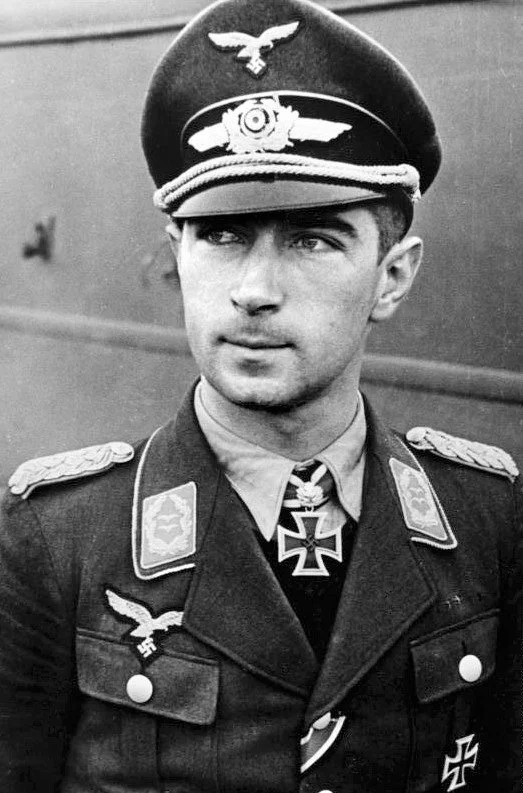
Just one week earlier, Reichminister of Aviation Hermann Goering had personally awarded Molders the Knight’s Cross of the Iron Cross - Germany’s highest military honor at the time - for having shot down more Allied planes than any other Luftwaffe pilot.
Molders’ 24th and 25th kills had been notched on the morning of June 5. That afternoon, after a return flight to a German airfield to refuel and rearm, his squadron flew back to France in pursuit of additional victims. Finding empty skies, the Germans turned for home. Soon though, specks on the horizon became small dots, and then larger, fast-moving, pulse-stirring targets. It was a cluster of Moranes, the principal fighter aircraft of the French Air Force. Molders flew with his men into a furious dogfight.
A loud noise and a jarring thud that shook his plane jolted Molders. As he later recalled, “suddenly there is a loud bang and sparks throughout my cabin.” Flames and smoke slowly filled the tight confines of his cockpit, his gauges were frozen and his joystick was unresponsive; he had no ability to control his Messerschmitt 109. Shocked and surprised, Molders had not seen the French plane that shot him. A French pilot had found a blind spot in Molders’ peripheral instincts. He was unharmed – at least for the moment - but his plane was fatally disabled. With no other option, Molders forced back his canopy, unbuckled his harness, stood on his seat, and jumped out into the warm air. As his parachute opened and he slowly descended, remarkably calm as the dogfight continued to flare around him, Molders literally had a birds’ eye view as his Messerschmitt plowed into the French soil and exploded in flames.
The moment Molders landed and freed himself from his parachute harness, he threw off his fur-lined bomber jacket and dove to the ground, attempting to crawl his way to safety through a dense field of long-stemmed lupins. But, “the French come running along from all sides – already the edge of the forest – a shot goes by my ear.”
As the free-firing Frenchmen cut closer and closer with their shots, Molders rose to surrender, holding both hands high in the air. He found himself surrounded by about fifty men, an angry pack of farmers, and soldiers. As a French officer took charge and led Molders to a car through the gauntlet of would-be captors, he was hit by punches, by boots and by at least one rifle-butt.
By shooting Werner Molders out of the sky, the French had removed a special menace - the most accomplished ace in the world’s most dangerous group of combat fliers at the time.
After his short run for freedom ended with his rough capture, Molders - bruised and bleeding from a cut above one eyebrow - was taken to a French military camp for interrogation. His scant possessions included a pistol, his pay book, a wallet with 120 marks, and a photograph of Molders with Hermann Goering. His pistol was confiscated. His Iron Cross, which his initial captors had stripped from him, was returned.
Aerial combat was still a relatively new phenomenon in the early months of World War II. Despite their deadly cat and mouse clashes in which advantage shifted by the second at 350 miles per hour as they tried to kill one another, aviators considered their profession a unique brotherhood. They were still in the mode of what General Erwin Rommel referred to as Krieg ohne Hass – war without hate. Molders, who spoke some French, asked if he could shake the hand of the pilot who had shot him down. They never met. After downing Molders, Sous lieutenant Rene Pomier Layragues rejoined the battle, and was killed in air combat just about an hour after he brought down his German adversary.
Molders’ confinement in a prison camp near Toulouse lasted a bit less than three weeks. France accepted Germany’s armistice terms just seventeen days after his capture, and Molders returned to Germany. With France out of the war, the battle now moved to the skies above Britain.
Newly free, and freshly promoted to the rank of Major, Werner Molders returned to the air shortly after his return to Germany, and was quickly shot down once again. During a clash near Dover on July 8, his Messerschmitt was hit multiple times – its cooling system, gas tank and fuselage holed by bursts from a British Spitfire’s Browning machine guns.
Faced with a choice between parachuting into British captivity or gambling on his ability to nurse his hobbled plane back to his airbase, Molders made a snap decision to head for home. With the northern and western coastlines of France now part of the German occupied zone, the airbase that Molders now called home was much closer than it had been before the armistice - a relatively short flight to a captured landing field near Calais. Although his landing gear would not extend, as Molders later recalled, he was able to guide his Messerschmitt to “a smooth belly landing.”
After his plane slid to a stop, Molders opened his canopy, unbuckled his harness, but then could barely lift himself from his plane. “My legs were unusually weak,” he recalled, and he noticed then that his gear was spattered with blood. After being helped from his plane and driven to a field hospital, Molders learned that his left knee joint, his left foot and his thigh were fractured. “In the heat of combat I didn’t notice a thing.” He had no sensation of his wounds until his plane lurched to a rest.
With Britain and Germany mortally engaged in daily clashes in the air, Molders pressed for a quick return to combat. In early August, after just 11 days in a military hospital, the hastily patched-up Molders returned to the Battle of Britain. The Royal Air Force now had the opportunity to shoot him down for the third time. Of course the British tried, but they never captured or killed Werner Molders. They did, however, shoot down and capture his brother.
Staffelkapitan Victor Molders, one year younger than Werner, was also a Luftwaffe pilot. In October 1940, Victor Molders crash-landed his Messerschmitt after a dogfight in the waning days of the Battle of Britain. He was taken prisoner and never flew in combat again. Five years later, after Germany’s unconditional surrender, Victor Molders walked out of a British prisoner of war camp and returned to civilian life in Germany. Despite being shot down, captured, and then held in a British Prisoner of War camp for five years, Victor was the more fortunate brother.
After returning from his injuries, Werner Molders continued his deadly roll. On September 10, 1940, he became the first German pilot to have downed 40 Allied planes. Adolf Hitler personally awarded Molders the Oak Leaves to his Knight’s Cross of the Iron Cross. Molders was just the second German officer to receive that decoration.
Although the British did not shoot him down for a third time, Werner Molders did not survive the war. Ironically, this much decorated fighter pilot who had brought down so many French and British aviators, died as a passenger in another pilot’s plane. After Ernst Udet, one of the early architects of the Luftwaffe, died in the fall of 1941, Germany scheduled a hero’s funeral, in part to camouflage Udet’s death by suicide.
On November 22, 1941, Molders was a passenger on a flight of Luftwaffe officers on their way to Udet’s memorial service. Their plane crashed while attempting to land near Breslau in a thunderstorm. There were several survivors, but Molders was killed, suffering a broken back and a crushed rib cage. Werner Molders was buried in Berlin, near the graves of Udet and Manfred von Richthofen, Germany’s top ace in World War I. Molders was honored with a hero’s funeral. Hermann Goering gave his eulogy.
Although frustrating at times, and ultimately adding nothing to my book (it was one of the many tangents that hampered my productivity), this quest for a twice-downed German pilot was an interesting research challenge..
Thanks for reading.
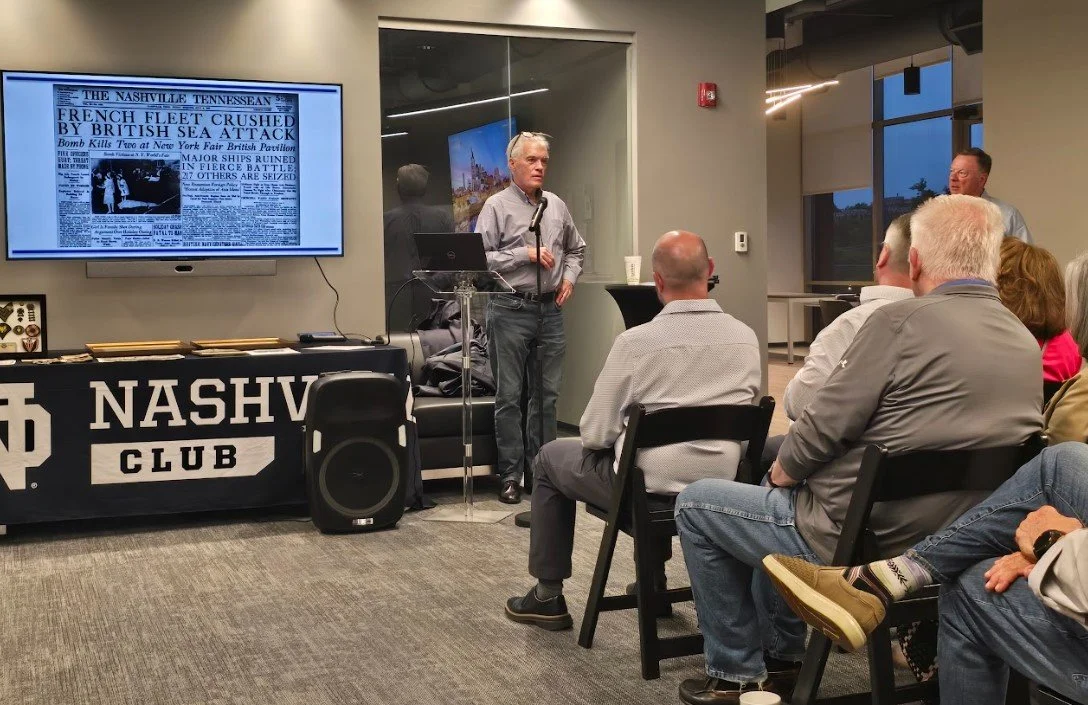
PS: Thanks to my good friend and former hockey teammate Gerry Hayden I had an absolute blast talking about Operation Catapult last week with the Notre Dame Club of Nashville, as well as a spirited group of Angel Eye Health team members, and at least two of Gerry’s Brazilian jiu-jitsu sparring partners.
PPS: I thoroughly enjoyed my conversation with Joe Ciccarone on his Built Not Born podcast. (Here's a link to a 42-minute video) Joe also shared these “3.5 Ideas from Bill Whiteside on Winston Churchill’s Darkest Decision” in his Built Not Born Blog: